Software
GForce releases official Oberheim Matrix-12 plug-in made with Marcus Ryle
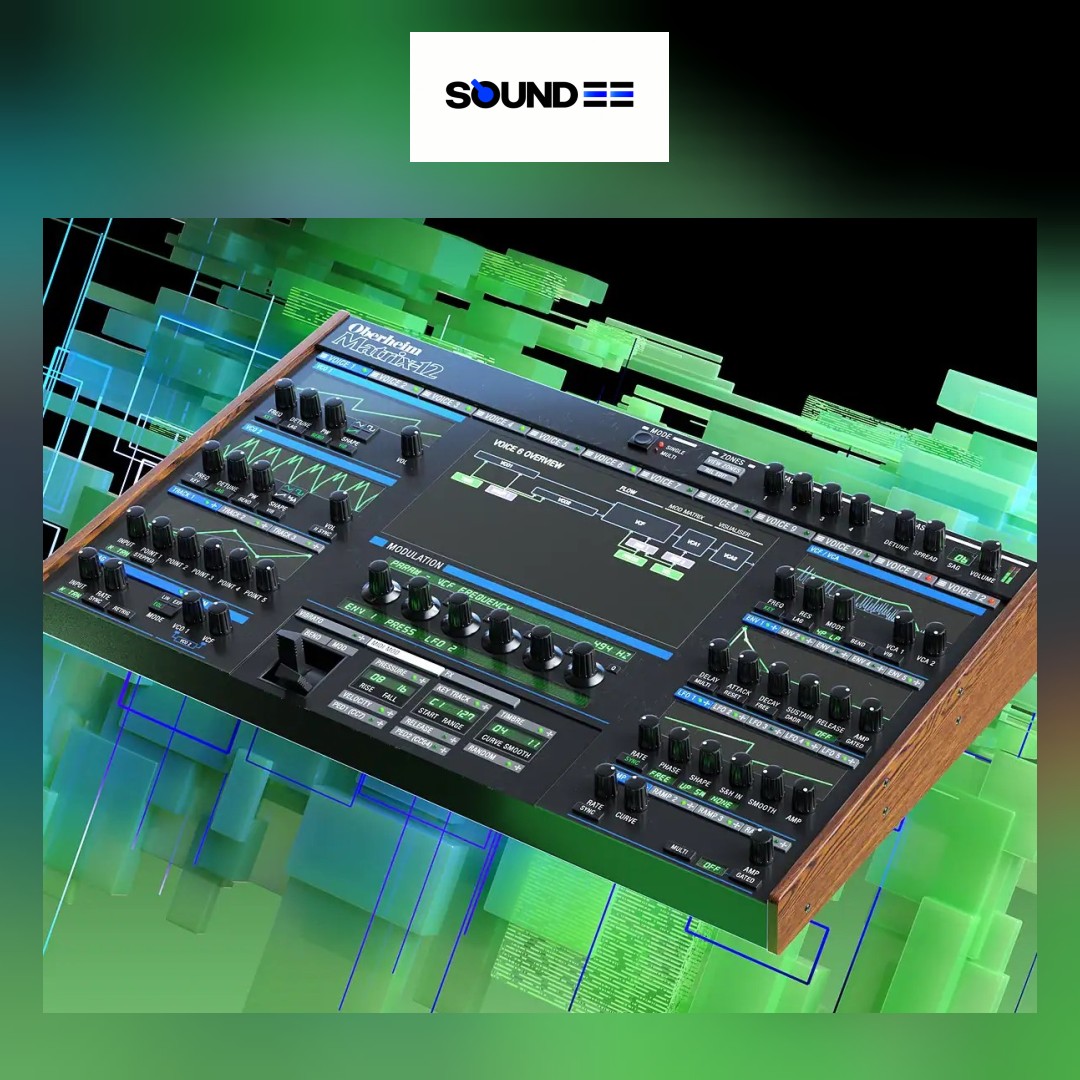
The licensed recreation of Oberheim's 1985 flagship keeps the 12 voices, the 15-mode filter and the dense modulation, and adds MPE and a visual mod matrix. Intro price $83.99 until 5 December.
GForce Software has released Oberheim Matrix-12, a software instrument licensed by Oberheim and developed with Marcus Ryle, one of the original 1985 synthesizer's designers. GForce describes it as the only official Matrix-12 and Xpander software. It is available now for macOS and Windows as a standalone app and in AU, AAX, VST2 and VST3 formats, at an introductory $83.99, £69 or €83.99 until 5 December 2026. The regular price is then $119.99, £99.99 or €119.99, according to GForce and Gearnews; KVR reports that the prices include VAT. A 14-day trial is available.
A difficult synth to model
The Matrix-12 was the most ambitious instrument Oberheim built. It had twelve analogue voices, each with two oscillators, and a modulation system that let almost any source control almost any destination. The Xpander, released a year earlier, was its keyboard-less sibling. Both are known as much for this depth as for being hard to program, with a large front panel, vacuum fluorescent displays and a printed routing chart.
According to GForce, the software reproduces the architecture voice by voice. Each of the 12 voices has two modelled oscillators (triangle, saw and pulse, with noise, hard sync and FM on the second) feeding a 15-mode filter with low-pass, high-pass, band-pass, notch and phase responses, followed by two VCAs in series. Each voice has five envelopes, five LFOs, four ramps, three "trackers" (which reshape a control signal through a curve) and a lag processor. GForce says it modelled the oscillators, filter and envelope shapes against the hardware, with Ryle working alongside the team. That is a claim about the method and does not guarantee the result.
What has been added
Most of the changes deal with the original's main weakness, which was seeing what was happening. Modulation is assigned by drag and drop, with six bipolar slots per parameter. Three views show the patch as a live signal-flow diagram, as a sortable modulation matrix, or through a visualiser. Multi mode splits the twelve voices across six overlapping keyboard zones. Each zone has its own MIDI channel and a micro arpeggiator, which reflects the original's multitimbral design. Single mode stacks all voices with unison, detune and stereo spread.
Performance additions include MPE (MIDI Polyphonic Expression, per-note pitch and timbre control from compatible controllers), release velocity, pressure with rise and fall, and four global macros. There is also a stereo delay and a reverb with per-voice sends. The library holds more than 570 patches, including over 190 original Matrix-12 and Xpander sounds. Requirements are modest: macOS 10.15 or later, Windows 7 or later, and 8GB of RAM.
For most producers, a software version is the practical way to work with this architecture: twelve voices that can be set up as one large polysynth or split into six independent parts. The official licence, and Ryle's role in development, are what distinguish GForce's version from a generic emulation, at least on paper.