DJ equipment
Devious Pocket: vinyl returns to dominate digital. And the laptop stays at home
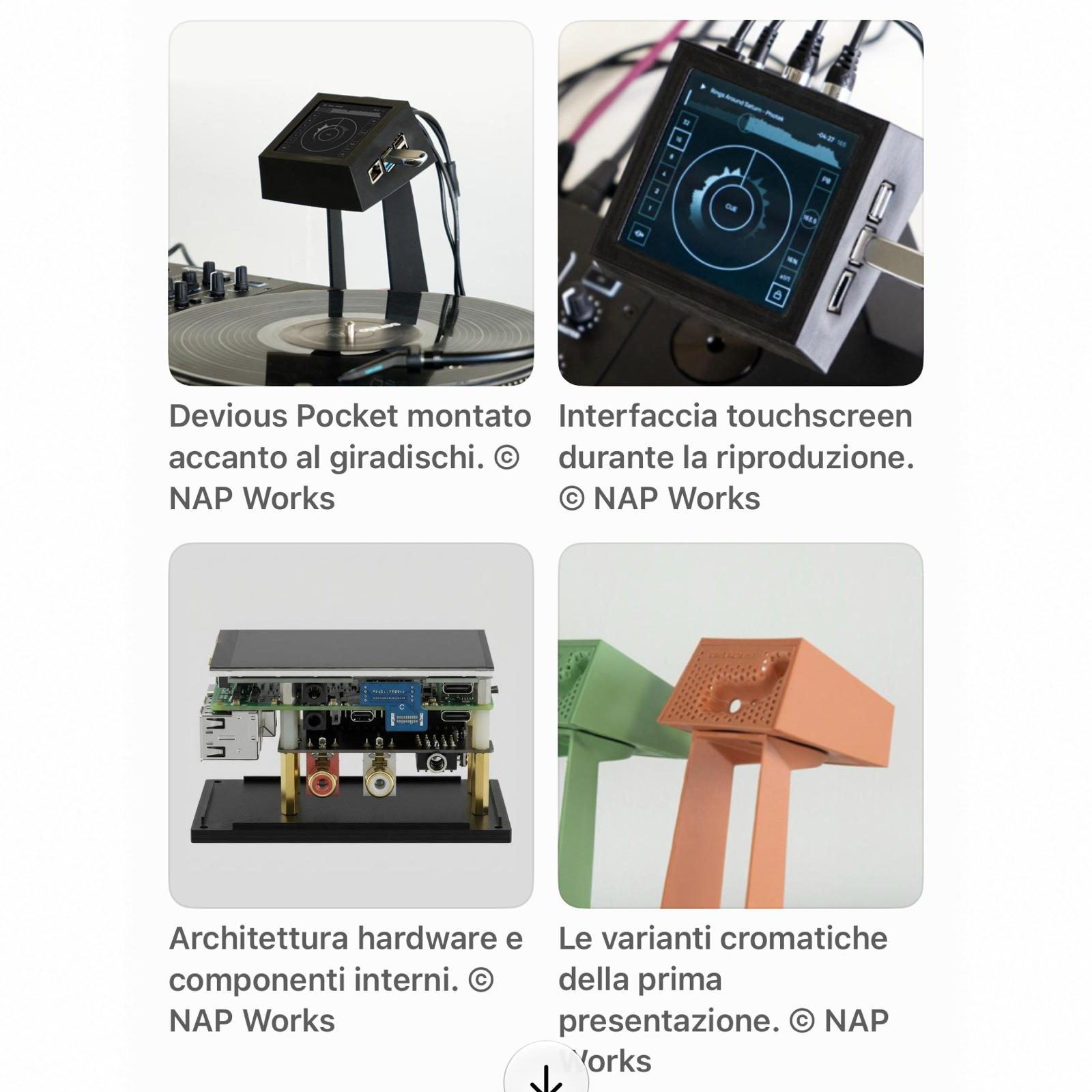
A small device from NAP Works promises to turn any traditional turntable into a standalone DVS system. We looked at specs, documentation, independent testing, and public feedback to understand what works, what limitations remain, and who has actually shown it in action.
An old question, a pocket-sized answer
Over the last twenty-five years, DJs have learned to live with a compromise: continuing to feel the vinyl under their fingers, but entrusting the music to a computer. DVS (Digital Vinyl System) systems made it possible to control audio files through a disc recorded with a reference signal, the so-called timecode. The gestures are those of the turntable; the song, however, is a sequence of bits. The computer interprets the needle signal, loads the file and produces the audio.
From Amsterdam comes a proposal that cuts the knot in an interesting way. It's called Devious Pocket and is made by NAP Works, a small European studio that develops software-based devices. It is a compact box with a four-inch touch screen: it connects between the turntable and the mixer, reads the songs from a USB memory and directly interprets the timecode disc. The laptop disappears from the workstation. Not because the calculation disappears, but because it is entrusted to the microcomputer contained in the device.
The difference is not just aesthetic. Those who already own a pair of Technics, or other turntables, can continue to use them as main instruments even when they want to play a song only available digitally, their own production, an edit or a track not released on vinyl.
How it really works
The operating principle is simple, but the signals must be distinguished. The timecode record signal comes out of the turntable head, which enters the Devious Pocket via a 3.5mm mini-jack input, usually via an RCA to mini-jack cable. The device decodes the movements of the vinyl and applies them to the selected audio file from the USB stick. The HifiBerry digital-to-analog converter produces the sound, which reaches the mixer via the RCA outputs. Power comes from the USB-C port.
It is therefore not a vinyl player that automatically "digitizes" traditional discs, nor a stand-alone turntable: to work as intended it needs a turntable, a mixer, a file source and a compatible timecode disc. For two turntables you need two Devious Pockets, one for each turntable.
The pass-through function is interesting: you can switch from playing the file to listening to traditional vinyl through an integrated digital phono preamplifier. It is the true playground of the product, designed for hybrid sets in which analog and digital are not two separate locations.
Essential hardware and DJ features
Inside we find a passively cooled microcomputer, a HifiBerry DAC and components available on the market. On the front, the four-inch high-resolution display dominates; on the sides there are four USB-A ports, two USB 2.0 and two USB 3.0, as well as Ethernet connectivity. The shell is 3D printed. There aren't a multitude of buttons, additional jog wheels or pads: the turntable remains the real controller, while the screen is used to choose songs and manage functions.
The device offers cues, loops from 1 to 32 bars, pitch range adjustment and BPM lock. When you set a reference tempo, the system can prepare a new song to match the locked BPM. However, this is not the same as automatic network synchronization between two devices: the two decks remain independent, and the DJ must still check the musical alignment.
Declared formats include MP3, FLAC, WAV, AIFF, CAF and OGG, with 24-bit/48 kHz audio output. Pay attention to an often overlooked detail: 24 bit/48 kHz describes the converter's output, it doesn't magically turn a compressed MP3 into a high-resolution recording. However, AAC/M4A and Apple Lossless are not among the formats listed in the official documentation.
USB storage can use FAT32, exFAT, EXT4 and NTFS file systems. The system reads music folders and metadata; according to the manufacturer it also manages SSD drives connected via USB. It does not require proprietary software to prepare the library: it is sufficient to organize the files in folders, but a computer remains useful for copying them to the flash drive.
Compatibility: the difference is in the details
NAP Works lists Serato 2, Serato CD, Traktor 1, Mixvibes V2, Mixvibes 7, and Pioneer timecodes as supported. The manufacturer recommends Serato Control Vinyl 2, which was used as a reference in development. There is one important caveat: the documentation warns that Traktor version 2 and later timecode vinyls employ a format that the device does not interpret correctly; Traktor 1 support is also listed as untested with a disc currently in production. It is a compatibility to check before purchasing.
It can also be used with Phase DJ, the system that detects movement without relying on traditional needle reading. A potentially interesting combination for those who work with scratch and energetic performances, although it does not equate to a certification of every possible configuration.
The integration with Rekordbox also deserves an upgrade compared to the launch items. In spring, the lack of compatibility with playlists was reported; from firmware 1.2.0, however, the official documentation describes the experimental import of playlists exported as .txt files together with the musical structure on USB. The system can retrieve BPM and key from the playlist. It doesn't mean importing the entire Rekordbox ecosystem without residue: hot cues, beatgrids, history and all proprietary information are not transferable like on a CDJ. The company advises caution, defining this function as experimental.
What about latency? What is measured and what is declared
The most seductive promise is the record's immediate response. NAP Works claims an internal processing latency of 0.666 milliseconds and separately reports additional transmission latencies in the range of 1–2 milliseconds, citing HifiBerry audio technical data. These are interesting values, but should not be mistaken for an independent measurement of the entire chain, from the needle to the mixer output.
For a DJ, the feeling of control also depends on timecode tracking, buffering, signal quality, response to changes in direction and stability during a scratch. This is why the commercial term "zero latency" should be understood as a promise of a very rapid response, not as physically zero latency. To make a definitive statement, repeatable and comparative measurements on the device actually on sale would be needed.
The independent evidence is there. But what do they demonstrate?
The most significant finding is the video test by the well-known specialist Mojaxx, published on July 20, 2026 in the Beatport Tech series and relaunched by DJcity with the title Laptop-Free DVS Is Here! NAP Works Devious Pocket Review. It's not just a press release taken from a site: it's a dedicated video test of the device. It's the most useful starting point for looking at the interface, wiring, and behavior in a real session. However, we do not have an independent lab report with repeatable instrumental measurements of latency, noise or distortion.
Another in-depth study, published on July 20 by Grandmixer GMS on The Urban Influencer, expressly states that it is not a first-person test, but is based, among other things, on video evidence from Mojaxx. The article highlights a possible criticality in the behavior of reading the position of the disk: by lifting and repositioning the needle in a different point, the file could jump to the corresponding position. Anomalies are also reported near the final area of some control vinyls. It is a finding to be taken seriously, especially for turntablists, but without confusing it with a direct measurement carried out by Sound EE nor with a defect verified on all versions of the firmware.
More generally, the first articles by CDM, DJ TechTools, Bonedo and Gearnews describe the project and analyze its advantages and critical issues. These contributions are useful to contextualize it; they are not all equivalent to independent practice tests. A Mixmag Asia article that appeared in October 2026 also features the Devious Pocket, but the author says he's waiting to try a pair himself.
Who uses it, and who is just showing it off?
Here the verification work requires a clarification that a promotional article would tend to avoid. There is no verifiable list of resident, club or touring DJs who consistently employ Devious Pocket from public sources consulted as of October 24, 2026. This does not prove that users do not exist: it means that it would not be correct to invent endorsements or assign the product to professionals without a verifiable testimony.
However, there is a concrete presence on the calendar of one of the most important events in electronic music. On 21 October 2026, the Amsterdam Dance Event (ADE Lab) included in its program a brand demo of the Devious Pocket at Het Ketelhuis: speaker Carsten Goertz, project manager at NAP Works, and demonstration entrusted to Ghikhan. It is documentation of an announced public presentation, not evidence of stable adoption by the artist or a history of club performances.
The picture, therefore, is that of a product actually designed, marketed and subjected to at least one independent video review, but still without a large public base of field tests and testimonials of long-term use.
Open source, yes. But not entirely
Part of the interest around the project concerns the construction philosophy. Devious Pocket uses NAP Framework, an open source platform for real-time audiovisual applications, and hardware made up of commercial modules. It is a favorable approach to repairability and possible reuse of components. However, it does not mean that the entire device is an open hardware project or that its firmware is freely modifiable: the specific product software is proprietary.
The most concrete advantage is in maintenance: the manufacturer documents the update from USB and even the system recovery procedure via microSD. Naturally, it remains to be seen, over the years, how available components, displays, firmware images and assistance will be. The promise of repairability is worth more if it is accompanied by long-lasting support.
The real price of a two-deck setup
As of October 24, 2026, the official website indicates 279 euros for a single unit. The 249 euros mentioned in various articles date back to the initial launch phase and should no longer be presented as the current price without verification. The dedicated support is listed at 29.99 euros, the cable kit at 22.49 euros, the pair of Serato Control Vinyl at 35 euros, the display cover at 9.99 euros. Shipping costs and any taxes are confirmed at checkout.
A simple indicative calculation clarifies the starting cost: two units cost 558 euros, before supports, cables and control discs. With two supports, two cable kits and a pair of timecode discs it costs 697.96 euros, before shipping and any taxes, considering the prices of the accessories on display. The page also offers selectable configurations and bundles, the total of which must be checked directly when ordering.
It is not a product that replaces a pair of CDJs on its own: it requires a turntable, mixer and cabling. However, it makes compelling economic sense for those who already own the analog setup and want to add access to digital files without replacing their identity.
Practical limits, before purchasing
Some critical issues are not hypotheses: they are reported by the documentation itself. File searching is currently limited to the open folder and does not operate globally on the entire library. The four-inch on-screen control is elegant, but in a dark, crowded or wet booth it may be less immediate than physical buttons. Two drives do not automatically share library and playback status; BPM lock does not make two decks a networked system.
Cooling is passive and the manufacturer documents CPU temperatures normally around 60–65 °C, higher in hot environments. He suggests preferring USB 2.0 ports when USB 3.0 sticks develop too much heat. It also recommends a dedicated 5V, 3A USB-C power supply, explicitly warning against using regular phone or laptop chargers. These are not very spectacular technical indications, but essential for those who have to rely on a device during an evening.
A new tool, not a new standard
The Devious Pocket is interesting because it doesn't try to replace the DJ gesture with another interface. It does the opposite: it eliminates equipment from the chain and restores centrality to the platter, needle and record. At a time when DJ technology tends to concentrate functions in large software ecosystems, a small, serviceable box is a cultural as well as technical signal.
For the vinyl collector who wants to insert some digital tracks, for the house and techno DJ who already owns turntables and for hybrid sets in small spaces, the idea has clear potential. For those who practice intensive scratching, use very structured libraries or require total integration with Rekordbox and advanced functions, field testing remains essential.
Sound EE's opinion, for now, is an opinion on the project and on public feedback, not the result of an editorial test of the product. There's enough to consider Devious Pocket a serious innovation, and still too little to proclaim it a new professional standard. The final say will be up to the DJs after many hours of use, not the technical data sheet.